



Beyond the Data: Why Knowing Asian Americans Isn’t the Same as Understanding Them

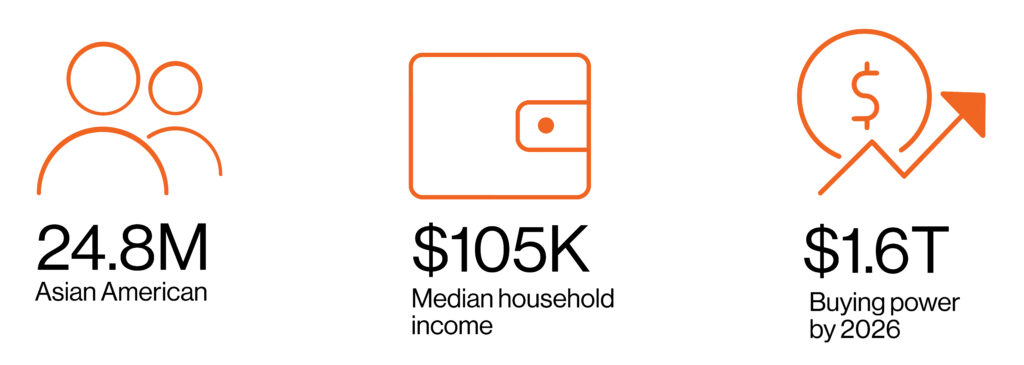
Ask a brand manager whether they know who the Asian American consumer is, and some may say yes. They’ll cite the numbers: 24.8 million people, a median household income exceeding $105,000, a buying power projected to hit $1.6 trillion.1 They’ll mention the over-indexing on consumer electronics, on travel, on premium grocery. A few will point to the Lunar New Year campaign they ran in February. And that, for most, is where the conversation ends.
Asian culture has never been more visible in American life — Lunar New Year activations, AAPI Heritage Month campaigns, the mainstream crossover of Korean pop culture and cuisine. And yet most campaigns aimed at this audience still feel like they were built from the outside looking in: technically accurate, culturally thin. The problem isn’t that brands don’t know Asian Americans exist. The problem is that knowing a segment exists has been mistaken for understanding it. And in that gap between data fluency and cultural fluency, most of the opportunity is being left on the table.
The In-Language vs. In-Culture Distinction
Perhaps the most misunderstood gap in multicultural marketing is the difference between in-language and in-culture.
Translating a campaign into Mandarin or Vietnamese says: we know you exist, and we’ve made our message accessible to you. But in-culture marketing asks a harder question: does this message actually reflect how this audience lives, thinks, and makes decisions? Those are not the same thing, and Asian American consumers know the difference immediately.
Content that reflects culturally specific truths — the particular pressures and pride of an immigrant family, or the experience of holding two cultural identities at once — lands differently than content that simply features Asian faces. According to Nielsen, 57% of Asian American consumers pay more attention to ads that reflect their culture, and they are 46% more likely to purchase from brands that show up in culturally inclusive content.2 3 The difference between those numbers and what most brands achieve comes down to one thing: recognition, not mere representation.
Cultural Context Varies by Category
Behavioral data can tell you that Asian Americans over-index in a given category. It rarely tells you why — and the why often changes everything about how a brand should show up.
Take healthcare. Asian Americans access and engage with the healthcare system at lower rates than their income and education levels would predict.

It’s ironic that the paragon of Asian-American achievement is becoming a physician but Asian Americans significantly underutilize health care when compared to white patients.
— Dr. Sherman Leung, Margins of Medicine

The gap isn’t primarily about affordability or awareness. In many communities, it reflects deeply held attitudes about privacy, self-reliance, and the cultural stigma around certain conditions — particularly mental health. A campaign built around access misses the actual barrier entirely — solving for a problem the audience doesn’t have.
Financial services carries a different kind of complexity. Many Asian American households — particularly first-generation immigrant families — approach wealth-building through a lens of intergenerational obligation rather than individual aspiration. Saving isn’t just a personal goal; it’s tied to family duty, supporting relatives abroad, and building security across generations. A campaign framed around personal freedom or individual achievement can feel misaligned with the actual values driving financial decisions in these households, even if the product itself is a perfect fit.
This type of nuance applies to every category. The cultural meaning of a product is rarely the same as its functional meaning — and for Asian American consumers, that gap is often wider than brands expect.
Brands genuinely trying to get cultural marketing right should be encouraged to know that the audience will notice when they show up thoughtfully. They’ll notice even faster when they don’t. Cultural credibility, once earned, compounds, but so does the cost of having skipped it.
- Pew Research Center, Key facts about Asians in the U.S., May 1, 2025, URL: pewresearch.org/short-reads/2025/05/01/key-facts-about-asians-in-the-us/
- Nielsen, Breakthrough ROI: Investing in Asian American Audiences and Media, April 23, 2025, URL: nielsen.com/news-center/2025/nielsen-report-asian-american-audiences-are-reshaping-sports-digital-media-and-beauty-trends/
- Nielsen, Seen, Heard, Valued: Engaging Asian Americans Through Media, April 26, 2023, URL: nielsen.com/insights/2023/seen-heard-valued-engaging-asian-americans-through-media/